
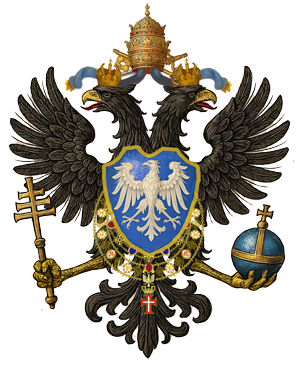
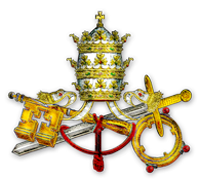
The Roman-Ruthenian papal insignia, combining the Key of St. Peter and the Sword of St. Mark.
It is also seen, either in whole or only the tiara, in the heraldic and other symbology of the Roman-Ruthenian Church and State.
See also About the Roman-Ruthenian Papacy
See also the Apostolic Constitution on the Roman-Ruthenian Papacy.
See also the Church's Canonical Status.
See also the Temporal Rights of the Church.
Read more on the Hierarchy of the Household in this article.
See the Historic Timeline of the Church.
Introduction
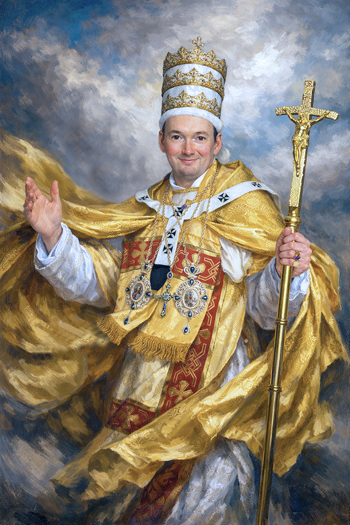
Legate of Christ (Legatus Christi) is one of the principal titles of the Roman‑Ruthenian Pope. It expresses the unique way the Roman‑Ruthenian Church understands the Petrine ministry of the Prince‑Bishop of Rome‑Ruthenia: as a mission entrusted directly by Christ, exercised fully within the Church’s own autocephalous life, and carried personally by the one who holds the office. This title reflects three core principles of Roman‑Ruthenian Orthodox and Catholic ecclesiology.
Copyright PGP Media 2025-2026. All Rights Reserved.
1. A Title of Mission: “The One Sent by Christ”
In classical Christian language,
a legate is someone sent with the
authority of the one who sends him. Applied to the papal office, Legate
of Christ means that Christ Himself sends the Roman‑Ruthenian Pope to
shepherd, teach, and govern the Church entrusted to him. This
emphasizes Christ’s active initiative, the Apostolic character of the
papal office, and the personal vocation of the one who holds it.
In this traditional theological framework, the Pope is not a substitute
for Christ, for Christ remains among us as the Supreme Priest. Rather,
the title highlights mission — a living commission rooted in the
Gospel’s sending of the Apostles.
2. Supreme Authority Within the URRC
The Roman‑Ruthenian Church is fully autocephalous.
Within this self‑governing Church — and in all matters pertaining to it
— the Pope exercises supreme authority, monarchical governance, and
universal jurisdiction. This authority is not derived from any earthly
source; it flows from the Petrine commission itself. Thus, Legate of
Christ means: “One who is sent to rule that which Christ has entrusted
to him.” The Pope’s jurisdiction is bounded by the URRC’s autocephaly,
but his office is not diminished by geography or circumstance.
3. A Petrine Office That Does Not Disappear Outside the Roman‑Ruthenian Church
The Roman‑Ruthenian Pope does not claim jurisdiction over other autocephalous Churches. However, his papal dignity remains and is not set aside. He does not adopt the signs of a subordinate bishop, and the obligations of his office do not permit him to acknowledge any earthly superior.
This reflects a key distinction:
Jurisdiction is limited to the Roman‑Ruthenian Church and all that
pertains to it. The Petrine office itself is universal in dignity.
This mirrors the early apostolic pattern: Peter’s authority was
personal and divinely given, not geographically confined, even though
governance of particular churches was entrusted to others.
This also applies in civil contexts. The Pope does not seek to govern
civil authorities, yet anything that touches the Church entrusted to
him or the faithful under his care pertains to his office wherever
he stands.
4. A Distinctive and Ancient Model of Primacy
The Roman‑Ruthenian understanding
of Legate of Christ avoids two extremes. First, it does not claim
universal jurisdiction over all autocephalous Churches. Second, it does
not reduce the papal office to mere honor or ceremonial primacy.
Instead, it presents a balanced, ancient model of real primacy, real
apostolic authority, real monarchical governance within the URRC and
all that pertains to it, and real independence from any earthly
superior, all expressed through the language of mission, not domination.
Conclusion
The title Legate of Christ means that Christ sends the Roman‑Ruthenian
Pope with a unique apostolic mandate. He governs the Roman‑Ruthenian
Church with full and supreme authority. His Petrine dignity remains
intact everywhere, even where his direct jurisdiction does not extend.
His
office is built on the foundation of mission, continuity, and the
living apostolic tradition. It is a title that captures the heart of
Roman‑Ruthenian identity: faithful to the ancient Church, respectful of
other authentic
autocephalous traditions, and grounded in the enduring mission Christ
entrusted to Peter.