A Brief Summary and Introduction
The Russian-Yugoslavian Order of St. John represents the living
continuation of the historic medieval Knights of St. John as they were
subsequently established
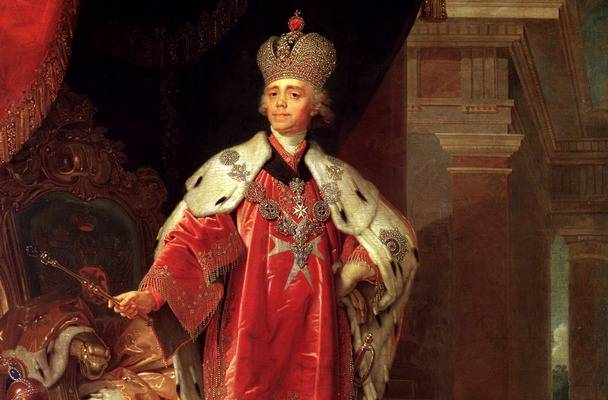
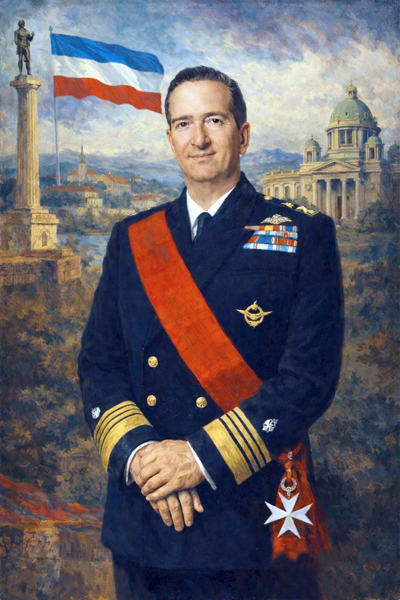
under Tsar Pavel I of Russia and later entrusted to the protection of
King Peter II of Yugoslavia. Rarely conferred, it honors those who
exemplify service to others. Although the Russian-Yugoslavian order
does not function as a serving order, its knights and dames are still
expected to help the poor, the sick, and those in need. While the
Church maintains its own historic Russian-Yugoslavian continuation, it
affirms respect and Christian fraternity toward all legitimate
traditions descending from the ancient Hospitaller heritage.
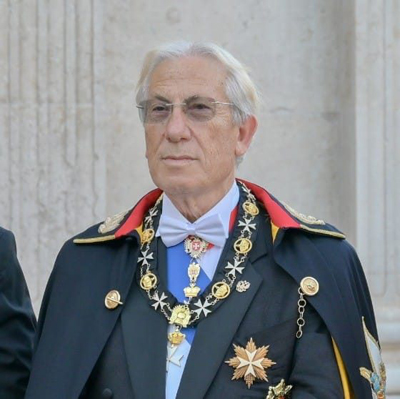
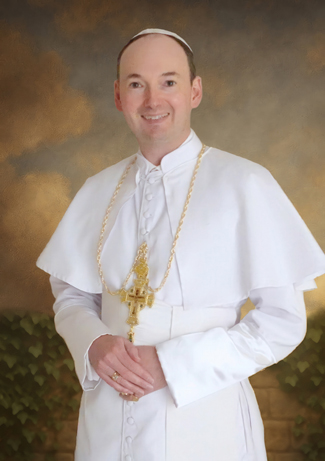
Left: H.A.H. Radislav I, Roman-Ruthenian Pope, Sovereign of the Order
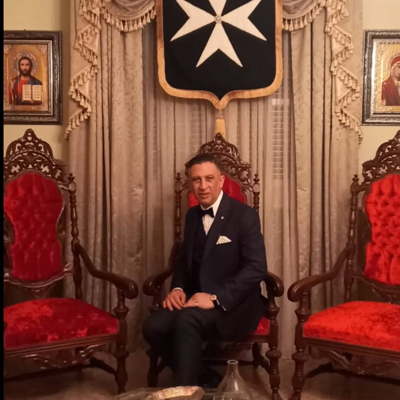
Right: H.R.H. Sire Rubén Gavaldá, Head of the Royal Merovingian Dynasty, Royal Protector of the Order
HERITAGE AND HISTORY
After the fall of Malta in 1798, the Russian Emperor granted sanctuary
and recognition to the displaced knights, forming the Russian Grand
Priory and accepting the title of Grand Master, thus establishing the
first Orthodox branch of the ancient Order. This Russian tradition
endured within the Imperial House of Romanov and, in the early
twentieth century, was transferred to the Royal House of Yugoslavia to
preserve its continuity amid the upheavals of revolution.
Florentine painting of Salome holding the head of St. John the Baptist. St. John is the patron
saint of the order, from whom the order takes its name.
King Peter II revived the Order in exile and confirmed its statutes in
1964. It is from this Yugoslavian line, historically linked to the
Russian Order and later Grand Priory, that the present
Russian–Yugoslavian Order descends. Following the death of King Peter
II and the dormancy of the Yugoslavian monarchy, its heritage came to
be under ecclesiastical protection so that its historic chivalric and
charitable ideals might endure.
Today, this continuation is maintained within the United
Roman-Ruthenian Church and the Pontifical Imperial State of
Rome-Ruthenia, in concordat with the Russian branch of the Order under
the Grand Mastership of H.H. Don Basilio Calě, Prince of Rhodes, and
under the royal patronage of H.R.H. Sire Rubén (Estčve IV) of the
Merovingian Dynasty.
His Apostolic Highness the Most Holy Pope Radislav I of Rome-Ruthenia
serves as Sovereign of the Order. This dignity is linked to the
pontifical office and is regarded as a mark of the Church’s duty to
preserve the chivalric legacy of Tsar Pavel I and King Peter II.
However, the order under the United Roman-Ruthenian Church is not an
active serving order like the Russian branch. And, the Church confers
the honors of the Order only on rare and exceptional occasions, solely
to uphold its historical and spiritual patrimony as a continuation of
the same timeless mission of Fides, Caritas et Servitium: Faith,
Charity, and Service.
Learn More...
The
Order of St. John has long stood as one of
history’s most revered chivalric orders, tracing its roots to the
medieval Crusades. Originally dedicated to the care of the sick and the
defense of Christendom, the order’s influence extended far beyond its
initial establishment in the late 11th century. After the loss of the
island of Malta in the 18th century, Russian Emperor Paul I gave
sanctuary to the largest contingent of knights. There it found a new
chapter in is history under the patronage of the Romanov dynasty. That
allowed its continued legacy to the modern era, where the Russian branch is under the
leadership of His Highness Don Basilio Calě, Prince of Rhodes, Grand
Master.
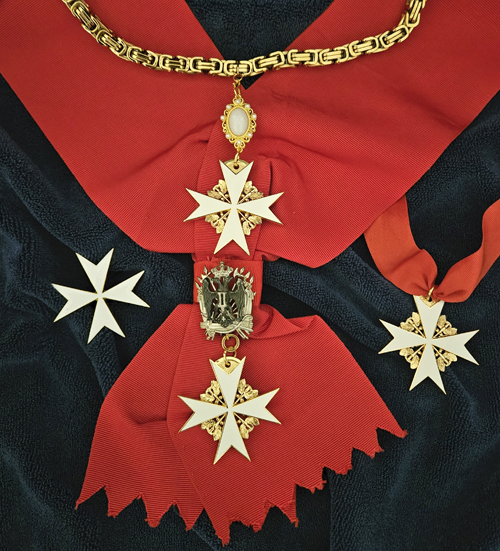
Regalia of the Order of
St. John as worn within the Roman-Ruthenian Church and State by His
Apostolic Highness the Roman-Ruthenian Pope, Sovereign of the Russian-Yugoslavian Order. This office descends with the office of
Prince-Bishop of Rome-Ruthenia.
The Knights of St. John in Russia:
The Era of Tsar Pavel I
The arrival of the Knights of St. John in Russia was largely shaped by the
vision of Tsar Pavel I, who ascended the throne in 1796. His deep
interest in the order—both politically and religiously—led him to
extend his protection to the knights after they were expelled from
Malta by Napoleon in 1798. Recognizing the strategic and symbolic value
of the order, Pavel I granted them refuge and established the Russian
Grand Priory, aligning Russian imperial interests with chivalric
traditions.
In a historic gesture, the Knights of St. John elected Pavel I as their
Grand Master—the first Orthodox Christian to hold this title.
He took this role extremely seriously, embedding the order within the Russian
imperial framework. Among those who held the order’s honors was the
legendary Admiral Fyodor Ushakov, a revered naval commander who never
lost a battle and was later canonized as a Holy Righteous Warrior of
God.
Holy Righteous Warrior of God Fyodr Fyodorovich Ushakov
The Order Under the Romanovi and Its Transition to Yugoslavia
Following the reign of Pavel I, the order’s activity in Russia
diminished, yet it remained part of the imperial patrimony. In the
turbulent era of Tsar Nikolai II, as the Russian Empire faced
revolution and upheaval, the tsar sought to safeguard the order’s
continuity. To ensure its survival, he transferred the responsibilities
and privileges of its Grand Mastership to the Royal House of Yugoslavia.
This transition, initiated as a means of preserving the order in the
face of Bolshevik rule, placed its leadership under King Peter II of
Yugoslavia. Even after his kingdom fell during World War II, King Peter
II remained dedicated to maintaining the order’s traditions while in
exile in Britain and the United States.
Original insignia of the Yugoslavian Order of St. John, with "trophy" (as it is called - in silver at the top of the medal) as a Knight Bachelor of Yugoslavia given to and owned by His Apostolic Highness Pope Radislav (Rutherford) I of Rome-Ruthenia. The trophy contains the Yugoslavian/Serbian double-headed eagle and the cypher of King Peter II of Yugoslavia in the centered, rendered in Cyrillic (П II).

Challenges and the Order’s Continuation
The mid-20th century was a challenging period for the order. King Peter
II, as well as the order itself, became subjects of misrepresentation
and defamation. Despite this, the order persisted, with a branch later
recognized by Prince Trubetskoi, a prominent Russian noble who had also served as Lieutenant Grand Master of the Order.
Today,
the rightful successor to the Russian Order of St. John—and by extension, to the historical Knights of St. John—is the Order
of St. John, led by His Highness Don Basilio, Prince of Rhodes. Under
his Grand Mastership, the order continues to uphold its foundational
principles of charity, hospitality, and faith, ensuring its relevance
in the modern world. The Russian-Yugoslavian (or Yugoslavian) branch of
the Order of St. John is perpetuated in the United Roman-Ruthenian Church.
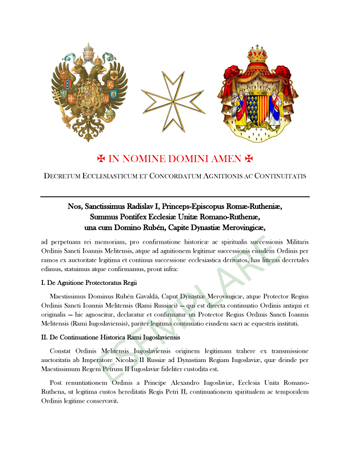
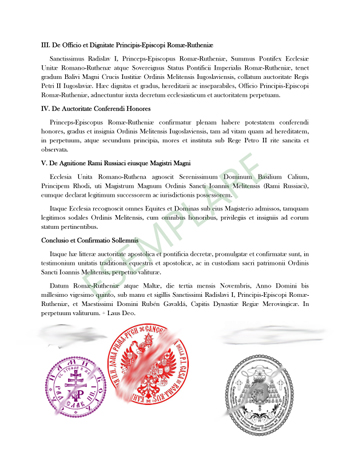
In 2025, a concordate between the two branches was signed.
Corcordat between the Russian and Yugoslavian branches of the Order
signed by the Prince-Bishop of Rome-Ruthenia and Sire Rubén, head of the
Merovingian Dynasty and Royal Protector of both branches of the Order.
His Highness Don Basilio Calě, Grand Master of the Russian Order
The Order’s Royal Patronage Carrying
forward the traditions of imperial and royal protectorship,
the Order of St. John is today under the patronage of the Royal
Merovingian
House, led by His Royal Highness Sire Rubén (Esteve IV). This patronage
reinforces the historical significance of the order and its rightful
place within the lineage of European chivalric traditions. His Royal
Highness is the Royal Protector of both the Russian and Yugoslavian
branches (see concordat above).
The Royal Patron of the Order,
H.R.H. Don Rubén Gavaldá (Esteve IV)
Head of the Merovingian Dynasty
The Legacy of the Order within the Roman-Ruthenian Church and State
Additionally, a strong connection exists between the Order of St. John and the
Roman-Ruthenian Church and State, which preserves important historical
records of King Peter II of Yugoslavia. The Church is among the few
institutions able to confer the rare title of Knight Bachelor
of Yugoslavia
and maintains the Pontifical Order of Knights Bachelor of
Yugoslavia. Furthermore, the Roman-Ruthenian Pope, Prince Radislav (Rutherford) I, holds the rank of Bailiff Grand Cross of the
Russian/Yugoslavian Knights of St. John. He was also previously recognized
as a Knight Commander of Justice of St. John by the branch under Prince
Trubetskoi. These ranks, recognized as hereditary, descend with the office of Roman-Ruthenian Pope (Prince-Bishop), which
itself is semi-hereditary, semi-elective. The equivalent female rank is
also held by statute by H.A.H. the Apostolic Princess.
The Roman-Ruthenian Chuch and State,
while recognised as possessing the authority to confer the Yugoslavian
Order of St. John, only extraordinarily rarely confers the honour on members
of the Pontifical Court as a special gift to perpetuate the legacy of
the order and Peter II of Yugoslavia.
Following the statutes of 1964 of Peter II, the categoroes of the order as currently used are:
1) Knights/Dames of Justice:
Grades: Bailiff/Grand Dame (the Prince-Bishop and Apostolic Princess),
Commander/Dame Commander, Knight/Dame. (Conferred by right of
hereditary nobility or ecclesiastical rank, recognizing those whose
titles or honors are founded in lineage or office.)
2) Knights/Dames of Grace:
Grades: Commander/Dame Commander, Knight/Dame (Conferred for merit,
service, or devotion to the Church or State, whether or not the
recipient holds hereditary nobility).
3) Knights/Dames of Honour: Grade:
Knight/Dame. (Conferred as a mark of esteem or friendship, often
honorary in nature, upon those of distinguished standing or special
connection to the Sovereign Church; and therefore they need not be
members of the Pontifical Court.)
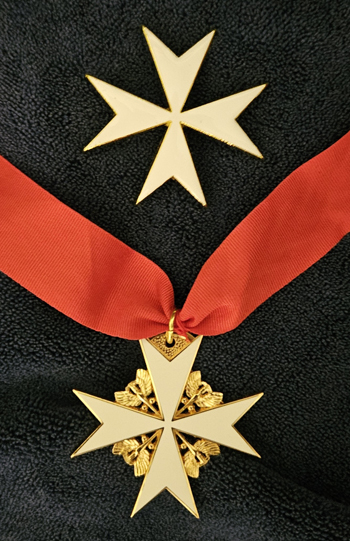
Neck insignia and chest cross in current use as conferred by the
United Roman-Ruthenian Church for all grades of the order.
The Charge of Service
As a Companion of the historic Order of Saint John in the line of Tsar
Pavel I of Russia and King Peter II of Yugoslavia, you are in-vested
not for your honor, but for your responsibility. This Order, born
of noble houses, preserved through the courage of exiled kings and
princes, and entrusted now to he care of the United Roman–Ruthenian
Church, exists for one purpose only: to serve Christ in the poor, the
suffering, and the forgotten. Therefore receive this charge:
I. You shall remember that the Cross you wear is not an ornament. It is
a summons to compassion, a reminder that Christ Himself is found in the
wounded, the hungry, the lonely, and the oppressed.
II. You shall give of yourself in real and practical charity. The Order
has no military to command, no palace to guard, no treasury to
main-tain. Its wealth is the mercy you give; its reputation is the
justice you do; its heritage is preserved only when its members bend
low to lift another.
III. You shall act with humility, dignity, and Christian courage. Let
your service, generosity, and compassion be steadfast. Do not
seek reward or praise; seek only to reflect the light of Christ to
those who dwell in darkness.
IV. You shall uphold the unity of the Church and the dignity of all
persons. Be a reconciler where others sow division, a defender where
others ignore the weak, and a bearer of peace where the world offers
conflict.
V. You shall remember that this Order stands under the blessing of the
Apostolic Church. Therefore your life must reflect the faith we
confess: Orthodox and Catholic, filled with charity, unwavering in
fidelity to Christ and His Gospel.
VI. You shall serve according to your state of life. Some give
re-sources, others time, others skill; but each must give something,
and none may claim that they have no duty.
And now receive the final exhortation: Go and
find the suffering Christ in your neighbor. Bind His wounds, lift
His burden, and love Him with both courage and tenderness. For in
serving the least of His brethren, you serve the Lord Himself. In this
way, you will honor the ancient legacy of Christian service of which
you are a part.
May the holy Apostle and Forerunner Saint John
the Baptist, the voice in the wilderness, defender of truth,
herald of repentance, guide you, protect you, and inspire you in all
works of mercy and faith. Amen.
H.A.H. Pope Radislav (Rutherford) I of Rome-Ruthenia,
then as a layman, in the church mantle of the
Royal Yugoslavian Order of St. John

H.A.H. Pope Radislav (then as Bishop of the Southwest, with a
delegation visting the headquarters of the separate Vatican-affiliated branch of
the Order of Malta in Rome.
Excerpt of brevet conferring
the rank of Knight Commander of Justice on H.A.H. Pope
Radislav I (then Marquis of Monte Titano).
This rank was recognized as hereditary by the Church and descends
specifically with the Prince-Bishop's office.
Excerpt of brevet conferring the Cross of Honor and Merit on H.A.H. Pope Radislav I (then Marquis of Monte Titano).
H.A.H. Pope Radislav (Rutherford) I , Roman-Ruthenian Pope
in the uniform of the Pontifical Ruthenian Naval Guard
(Pontifical Walsingham Guard), and the sash and cross of the
Royal Yugoslavian Order of St. John
 Lapel badge of the Russian-Yugoslavian Order of St. John as currently used within the Pontifical Imperial State.

Chain of the Prince-Bishop of Rome-Ruthenia with the insignia
of the Supreme Roman-Ruthenian Aquiline Order of Christ (centre),
the Most Holy Pontifical Order of the Eagle (left), and
the Russian-Yugoslavian Order of St. John (right)
A Legacy That Endures
The journey of the Knights of St. John—from their origins as a medieval
Crusader order to their integration into Russian sovereignty and
eventual transition into the modern Order of St. John—is a testament to
their resilience and historical continuity. Despite political upheavals
and shifting allegiances, the order has remained steadfast in its
dedication to the principles of chivalry, service, and faith.
Note:
The Russian–Yugoslavian Order of St. John, as described herein,
represents an independent continuation of the historic chivalric
tradition under the sovereign authority of the United Roman-Ruthenian
Church. No affiliation or recognition to or from any other modern body
using similar names is stated or implied. The information on this page
is presented solely for historical and ecclesiastical purposes within
the jurisdiction of the Church. All original text, designs, insignia,
and images are the
property of the Church and may not be reproduced without written
consent. Historical images are used with authorization or under
public-domain status.
Legal,
Copyright, and Trademark Notices
|