
Florence, Italy
Dedicated
to St. Stephen the Apostle and Archdeacon
An Historic Basilica of the United Roman–Ruthenian Church
The Basilica of Santo Stefano al Ponte, standing just steps from
Florence’s Ponte Vecchio, is one of the oldest surviving churches in
the city. Documented already in 1116, its origins almost certainly
reach back centuries earlier. Medieval Florentine tradition held that
the church already existed in the time of Charlemagne, and a mule
shoe said to have fallen from the emperor’s mount during his journey to
Rome in 800 was long displayed above its ancient door.
By the High Middle Ages, the church had become a center of civic and
religious life. Several Florentine guilds met here, and on occasions of
the election of the city leadership, the privilege of celebrating the
solemn Mass was bestowed upon the Prior of Santo Stefano. This was a sign of the
church’s standing in medieval Florence.
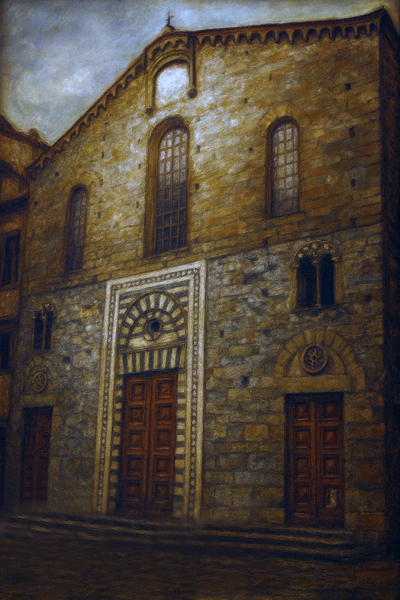
A depiction of the façade of the basilica
Santo Stefano went through three major architectural periods:
Romanesque (11th–12th centuries): The lower façade, with its characteristic geometric decoration in white
and green Prato marble, preserves this early style. The original
triple-portal arrangement attests that the church once had three naves.
Gothic (13th–14th centuries): The lengthening and widening of the nave, the construction of three
choir chapels, and the addition of mullioned windows all belong to this
phase. The church achieved its present medieval silhouette at this time.
Florentine Baroque (17th century): Beginning in 1585, after the church passed to the Augustinians of
Lecceto, the interior was entirely remade according to the refined
principles of the Florentine Baroque. Under the patronage of the
Bartolommei family, a dramatic, highly structured Baroque tribune and
choir were added, featuring pietra serena architecture, dodecahedral
geometric motifs, and a remarkable segmented dome inspired by
Brunelleschi.
The basilica today is an extraordinary architectural
palimpsest, with Romanesque foundations, Gothic elevation, and a Baroque
interior of striking depth and harmony.
Santo Stefano al
Ponte suffered greatly in modern times. During World War II (1944),
German forces demolished the buildings around the Ponte Vecchio to
block Allied movement. The 92-year-old parish priest, Don Pietro
Veneziani, refused to abandon his church and died during the
explosions. Santo Stefano was heavily damaged but survived.
Then there was the Flood of 1966. The Arno’s floodwaters struck the church severely.
Later came the Mafia Bombing of 1993 (Via dei Georgofili). A devastating explosion damaged the church once more, but restoration
uncovered new treasures, including a 15th-century fresco of Tobias and
the Archangel Raphael.
Though scarred, the basilica has always risen again — fitting for a
church dedicated to St. Stephen, the first Christian martyr and the
Church’s sign of indestructible faith.
The basilica
contains significant works of art, including Giambologna’s high altar
(transferred from Santa Maria Nuova); seventeenth-century Florentine
baroque carvings by Jacopo Sani’s
workshop; works by Santi di Tito, Matteo Rosselli, Mauro Soderini, and
others; and a sculpture of St. Stephen attributed to Giovanni Gonnelli.
The church's artistic program is one of the finest examples of
restrained, geometrically expressive Florentine Baroque.
The United Roman-Ruthenian Church designated Santo Stefano al Ponte as
one of its principal basilicas in Italy, with Santa Maria
Antiqua in Rome, because of its profound theological, apostolic, and
historical resonances.
A. Dedicated to St. Stephen the Apostle and Archdeacon
St.
Stephen is the proto-martyr, the first deacon, and according to
ancient Eastern tradition, numbered among the Apostolic circle. His
diaconal ministry, proclamation of Christ, and martyrdom embody the
foundational identity of the URRC, which upholds apostolic
continuity. St. Stephen is one of the four named patrons of the Holy
Apostolic See and is the Patron of the Diocese of Rome-Ruthenia.
B. A Florentine Church linked to Pope Saint Leo X
Santo Stefano stands in the historic heart of Florence, the city of
Giovanni de’ Medici, later Pope Saint Leo X.
Since the URRC is successor to Leo X, the Florentine location bears
symbolic significance for the history of the Holy Apostolic See.
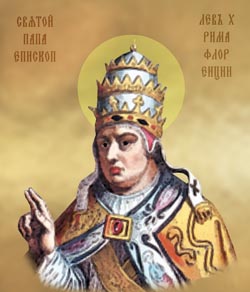
Icon of St. Leo X
C. A Sign of Unity Between East and West
Built in Romanesque forms, expanded in the Gothic period, renewed in
the Baroque era, and retaining art from many centuries, Santo Stefano
visually expresses what the URRC professes: the unity of Apostolic
tradition across time, cultures, and rites.
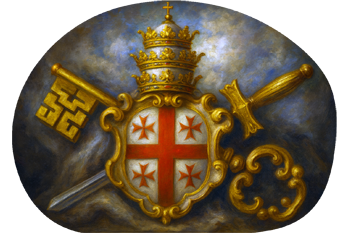
The coat of arms of the basilica, Argent, a cross Gules between four crosses of St. Stephen Gules, has
a unique and providential history within the United Roman-Ruthenian
Church. Before it became the non-territorial diocese that later
developed into what is now the Diocese of Rome-Ruthenia, the old Metropolitan See of the Southwest
used a distinctive flag, not originally conceived as a coat of arms.
This flag consisted of a red field on the left side bearing the actual
coat of arms of the original diocese and, on the right (outer) side, a
field that would later inspire the current basilica shield, i.e., a
white field charged with a red cross and four smaller St. Stephen
crosses arranged around it. At the time, this was not an ecclesiastical
coat of arms, nor even intended to function heraldically. It was simply
one half of the metropolitan flag.
Over time, the right-hand design (the white field with St. Stephen
crosses) began to be recognized as symbolically connected to both St.
George and the witness of St. Stephen the Apostle and Archdeacon. And,
it was long used as a coat of arms at the top of the diplomas of Pontifical Georgian College, a use that continues to this day even though the college has its own shield.
Thus, when the Holy Apostolic See elevated Santo Stefano al Ponte as
one of its principal basilicas in Italy, the ancient St. Stephen motif
was naturally chosen as its arms, giving the flag element a new
ecclesiastical life as a canonical emblem. It now functions on multiple
levels. In terms of historical continuity, it preserves the memory of
the old Metropolitan See of the Southwest. Also, the St. Stephen
crosses highlight the basilica’s dedication to St. Stephen the Apostle
and Archdeacon, the proto-martyr. It is perhaps an extremely rare case
in which a former flag element, rather than a coat of arms, organically
matured into a basilica’s formal heraldic shield.
With the dignity and status of a Basilica granted by the United Roman-Ruthenian Church, the church stands as a
monument to the apostolic faith, the perseverance of the saints, and
the unity of the Church built on the witness of the first martyr, Saint
Stephen the Apostle and Archdeacon.