
The Apostolic shrine of the Petrine succession
The basilica built around the tomb of St. Peter
St. Peter's in Rome is honored within the United Roman-Ruthenian Church as the Most Holy Patriarchal Basilica of St. Peter the Apostle.
The basilica's importance begins not with its scale, artistic magnificence, or place in papal ceremony, but with the modest grave beneath its high altar. From the earliest centuries, Christians came to Vatican Hill to venerate the burial place of the Apostle Peter. Every successive building was ordered around that sacred center.
Peter beneath the altar
The confessio, papal altar, Bernini's baldachin, and Michelangelo's dome all rise on the same vertical axis above the place venerated as the Apostle's tomb.
A shrine, not Rome's cathedral
St. Peter's is a papal basilica of singular importance. The cathedral church of the Bishop of Rome is the Archbasilica of St. John Lateran.
A home for the Christian world
Pilgrims of many churches and nations come to honor Peter, pray at the tombs of martyrs and bishops, and encounter the history of the Roman Church.
The reason for the basilica
The memory of Peter on Vatican Hill
Christian memory placed Peter's martyrdom in the persecution of Nero and his burial in the necropolis beside the imperial circus on Vatican Hill.
By the late second century, a small funerary monument—later called the Trophy of Gaius—marked the place. Pilgrims left invocations and graffiti nearby. Constantine's builders then enclosed this remembered tomb within the first great basilica, accepting the immense labor of leveling the hillside so that the church's altar could stand directly above it.
Excavations conducted from 1939 to 1949 uncovered the Roman necropolis, the early monument, and the successive architectural envelopes constructed around the venerated grave. The archaeological record makes visible what the basilica's design had always proclaimed: Peter's tomb is its fixed center.
Two basilicas, one Apostolic center
From the age of Constantine to the Renaissance
Martyrdom and burial of St. Peter
Ancient Christian tradition places Peter's martyrdom during Nero's persecution and his burial in the cemetery on Vatican Hill.
The Trophy of Gaius
A small memorial structure marked the grave already visited by the Roman Christian community and remembered in early testimony.
The Constantinian basilica
Emperor Constantine and Pope Sylvester established a monumental basilica over the tomb. Its great nave, transept, atrium, and shrine served pilgrims for more than a millennium.
The coronation of Charlemagne
On Christmas Day, Charlemagne was crowned Emperor in Old St. Peter's, associating the Apostolic shrine with the developing imperial order of medieval Western Christendom.
Foundation of the new basilica
Pope Julius II laid the first stone of a new church. Bramante's initial design began a building enterprise that continued through twenty pontificates.
Michelangelo assumes direction
Michelangelo simplified and strengthened the plan and shaped the great dome that would become one of the defining forms of Rome.
Maderno's nave and façade
Carlo Maderno extended the Greek-cross core into a longitudinal basilica and completed the great eastern façade facing the city.
Consecration of the new St. Peter's
Pope Urban VIII consecrated the basilica on 18 November, 1,300 years after the traditional dedication of its Constantinian predecessor.
Bernini completes the ceremonial setting
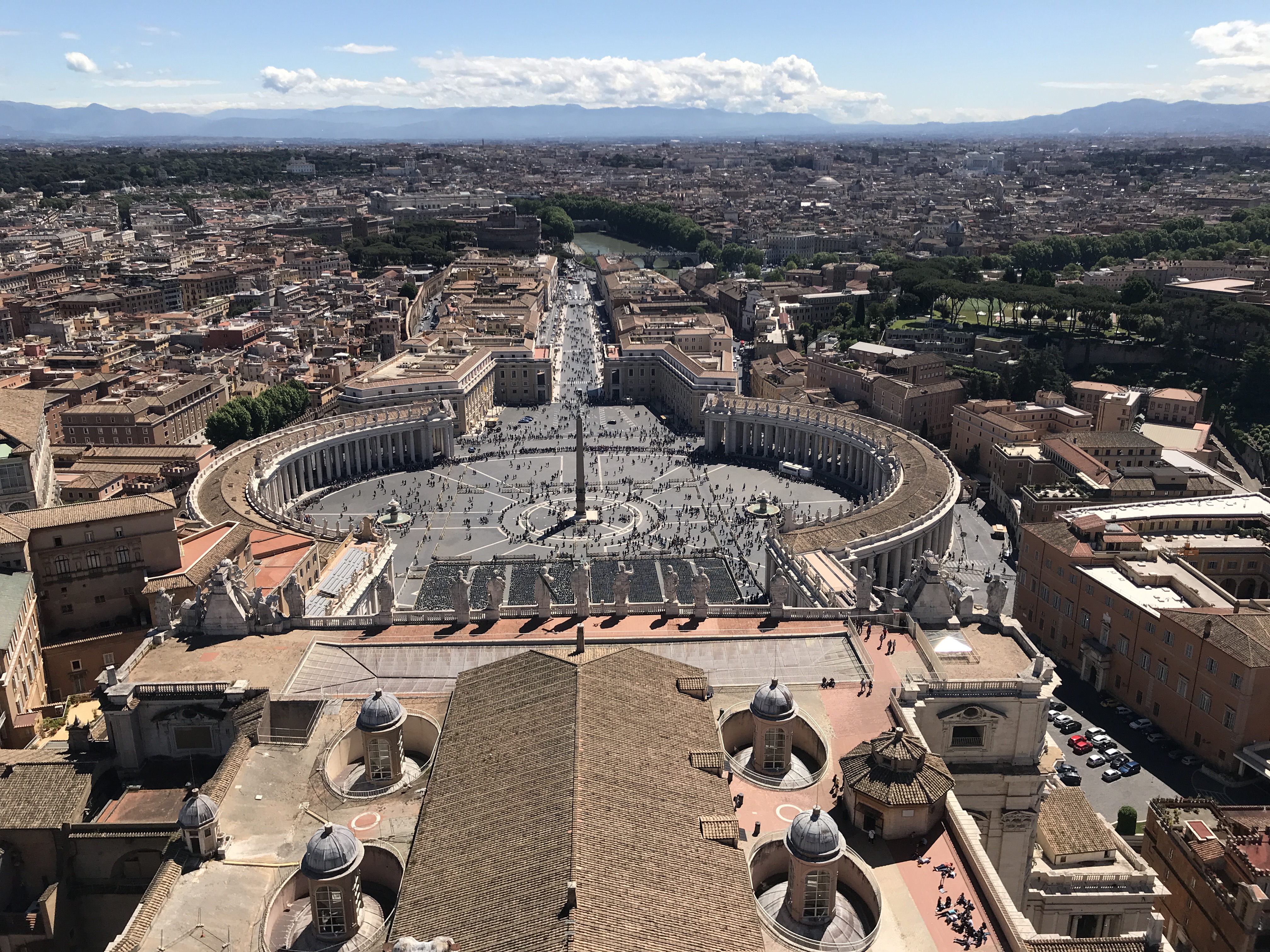
Gian Lorenzo Bernini created the bronze baldachin above the tomb, the Cathedra Petri, and the embracing colonnades of St. Peter's Square.
Excavation beneath the basilica
Twentieth-century archaeological work revealed the necropolis and the layered history of veneration beneath the confessio and high altar.
Architecture ordered around Apostolic memory
A collaboration across generations
St. Peter's is not the work of one architect or one pontificate. Its unity emerged from successive designs, revisions, and artistic campaigns that preserved the tomb as their immovable point of reference.
Bramante and the Renaissance ideal
The first plan envisioned a centralized martyrium whose balanced geometry would gather the whole building around Peter's grave.
Michelangelo and the dome
Michelangelo restored monumental clarity to the project and conceived the dome as both a structural crown and a sign visible across Rome.
Maderno and the pilgrim church
The extended nave increased the basilica's capacity and established the long ceremonial approach from the façade toward the Apostolic altar.
Bernini and the embracing square
The colonnades create a vast threshold between city and sanctuary, while the baldachin identifies the place where altar, tomb, and dome meet.
Present administration and shared Apostolic significance
A Petrine shrine honored across historic successions
The physical basilica is presently administered within the Roman Catholic jurisdiction by the Holy See through the Fabric of St. Peter. Its inclusion among the patriarchal basilicas of the United Roman-Ruthenian Church recognizes the sacred place itself: the shrine and burial site of St. Peter, honored by all the historic ecclesiastical successions that preserve a Petrine inheritance.
For the Holy Apostolic See of Rome-Ruthenia, St. Peter's expresses the source of its Latin Orthodox Petrine patrimony. The title does not depend upon the basilica being the cathedral of the Bishop of Rome—it is not—but upon its more ancient and universal identity as the memorial of Peter's martyrdom, burial, and continuing Apostolic witness.
Read about the Roman-Ruthenian Papacy and the Petrine inheritance.
The patriarchal basilicas
Continue through the sacred geography
The basilicas of the Holy Apostolic See preserve complementary Roman, Italian, Kyivan, and Russian dimensions of the Roman-Ruthenian inheritance.
Historical references: The Tomb of St. Peter · The Basilica — Fabric of St. Peter